Field Note 01 · On structure · September 2026 · 4 min read

The founder is
the first system.

Before brand, before offers, before any of the work I am usually hired to do, there is a system that already exists and is rarely examined: what the founder knows about herself and has never written down. Everything downstream inherits it, or inherits the gap.

A shophouse colonnade reflected in glass, the old building doubled in the new one
The old structure, still legible in the new one.

From the work

Behnoush Malek, luxury real estate, West Vancouver.

Behnoush Malek had a decade of luxury sales on the North Shore. Before she was licensed she spent seven years in luxury interiors, which means she reads a house the way a designer does. She works in English, French and Farsi, which means she can represent buyers and sellers most of her market cannot reach.

None of it was visible. Her website was a platform template under a large brokerage, and it led with a property search. It looked like every other agent’s site in the region, because it was every other agent’s site in the region.

That is what happens when the founder’s distinctiveness is never named. The business does not go blank. The category fills the space. The template, the listings feed and the stock phrases rush in, and a practitioner with uncommon expertise ends up presented as interchangeable.

What we built

Nothing about her expertise changed. We named it, then built the business around the name.

01
A position
The claim moved off price and size and onto judgement: light, quiet, sightlines, the details a trained eye notices. “Privately represented” became the organising idea.
02
A named offer
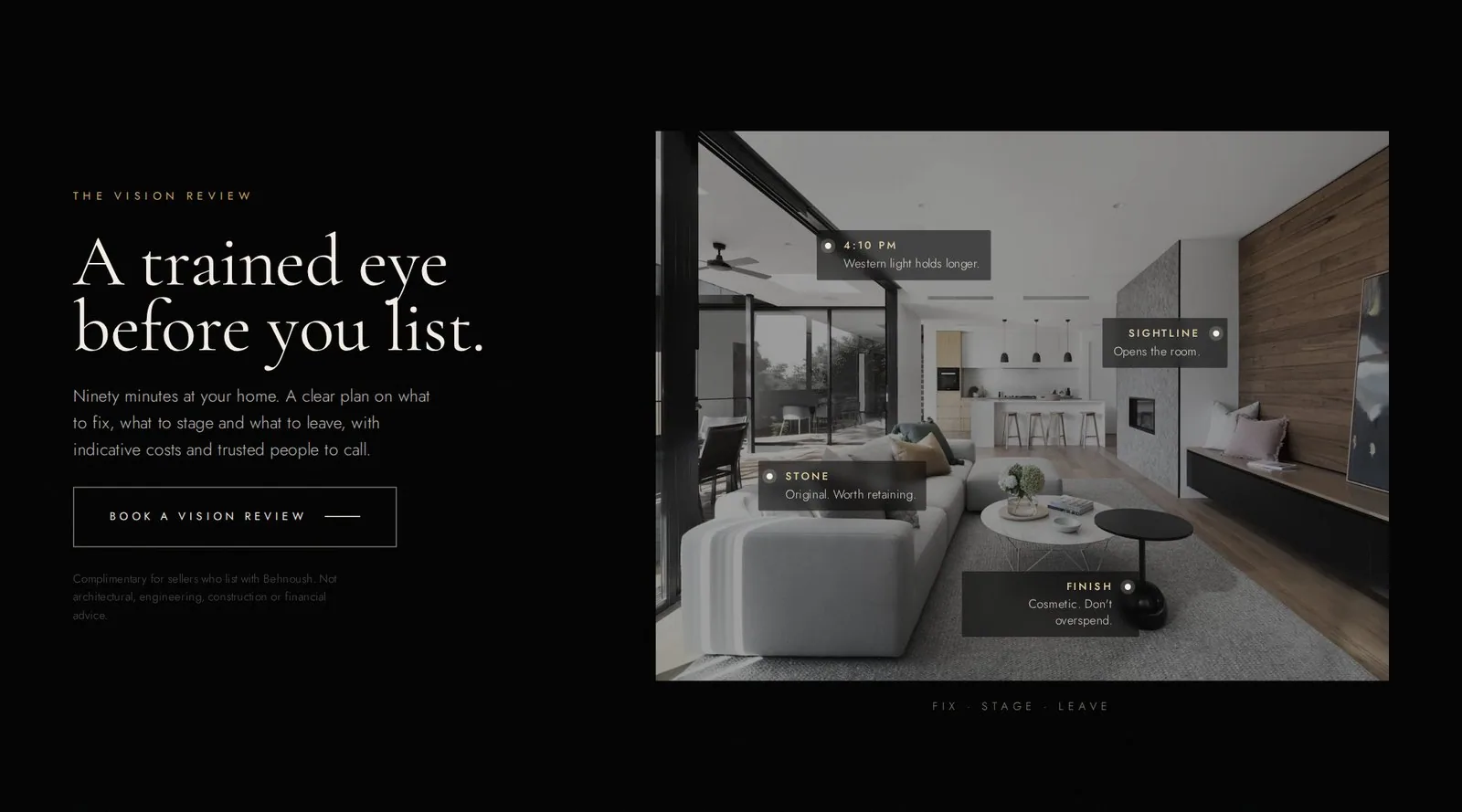
The Vision Review. Ninety minutes at the home, and a clear plan on what to fix, what to stage and what to leave. It turns seven years in interiors from a line in a bio into something a seller can book.
03
Three doors, not a menu
Sell, Buy and Relocate, each with its own page, its own promise and its own way in.
04
Three languages
English, French and Farsi across the whole site, not a translated brochure page. For an international buyer market, the language is the market-entry decision.

The result is an independent practice with its own name, a named offer and a $12.8M sale on the board. In her words: “It finally looks like the calibre of property I represent.” Read the dossier

The Vision Review page on behnoushmalek.com
Fig. 01The Vision Review, as it appears on the live site. A stranger can say yes to it.

Whatever the founder has not named, the business cannot show.

Why a brand exercise alone will not fix it

This is the part clients dislike hearing.

The instinct is to buy clarity: a positioning sprint, a rebrand, an agency. I sell some of those things, and I will still say it plainly. A brand exercise expresses a decision. It does not make one.

Run it over a founder whose distinctiveness is still unnamed, and you get a beautifully made version of the category default. The work is quieter than that, and it comes first.

Four questions to ask of your own business

They are not comfortable and they are not complicated.

01
What do you know that is not on the site?
Training, languages, a previous career, the thing clients mention unprompted. If it is not visible, it does not exist for a stranger.
02
What have you decided but not said?
A decision the team has to guess at works exactly like one that was never made.
03
What would a stranger have to do to find out if you are good?
If the only answer is “call me”, most of them will not.
04
What would you stop doing if you had already chosen?
The answer is always specific, and you usually know it already.

The principle

What travels from this to the next build.

Structure the founder first. Not because founders are the problem, but because they are the origin. Whatever the founder has not named, the business cannot show, and the market fills the gap with the category.

The letter

Shorter pieces, in The Eight.

Eight short things on brand, growth and taste. Four minutes, on Thursdays. Field Notes are the longer essays.